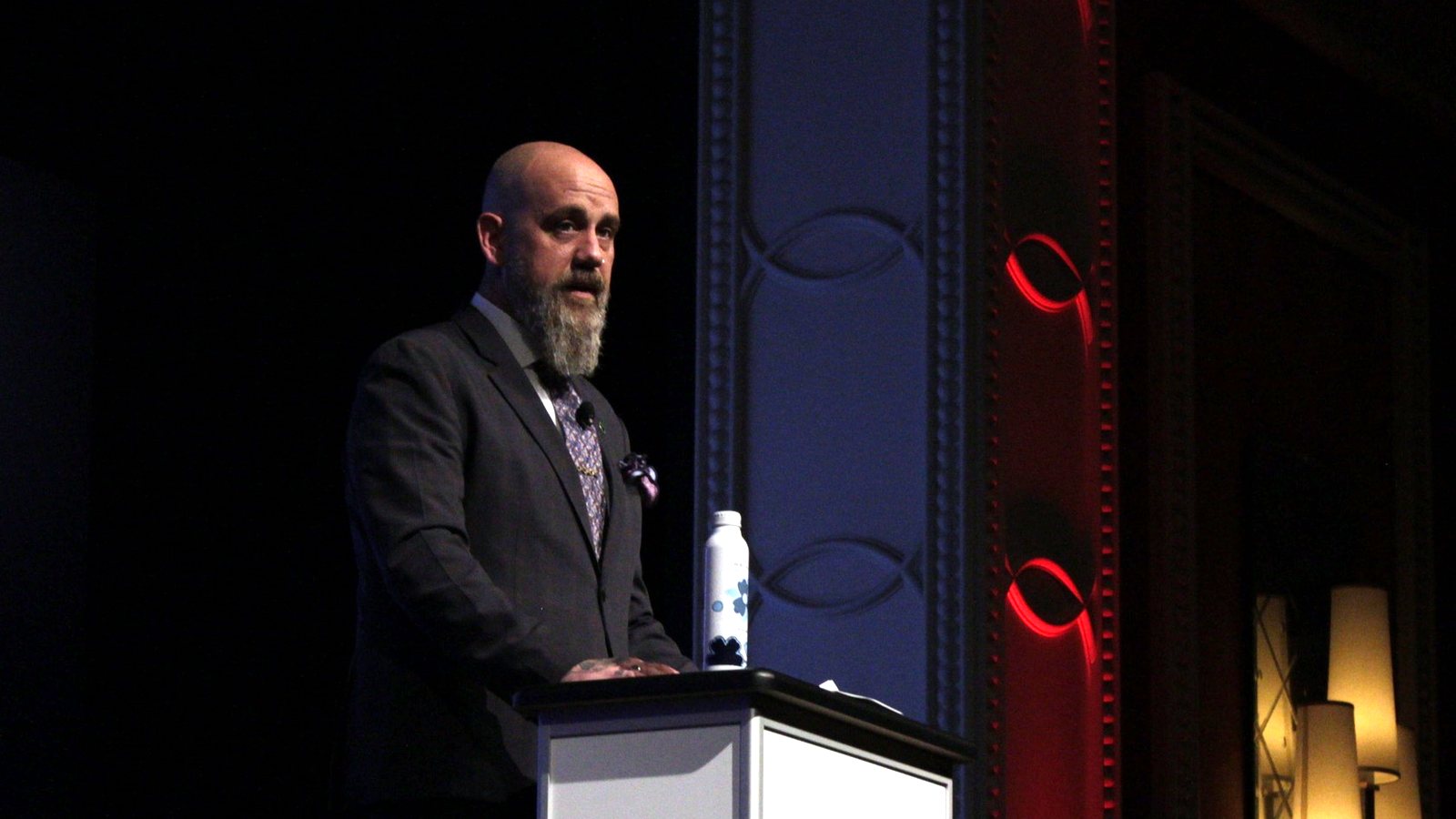
In his EC26 keynote, the chief operating officer of Colusa Indian Energy told utility leaders that ownership changed the equation for his tribe, and asked them to bring tribal nations in before the big decisions are made.
Ken Ahmann began his keynote at the OATI Energy Conference 2026 with a number.
“More than 50 power outages a year. That was the reality for the Colusa Indian community when I arrived back in December of 2004.”
Ken Ahmann, Chief Operating Officer, Colusa Indian Energy
Every outage interrupted business and reminded the Cachil DeHe Band of Wintun Indians of the Colusa Rancheria that its future depended on a system it did not control. “Today, we’ve gone more than 14 years without a single power interruption,” Ahmann told the room on October 7. “Same community, but with a fundamentally different energy future.”
What changed
The tribe built a cogeneration plant, developed its own distribution system and established a tribal utility authority, later adding solar and battery storage. Today it owns and operates a microgrid serving all of its lands: the resort, tribal government facilities, every tribal member’s home, water and wastewater treatment, thousands of acres of agricultural load and every business on the reservation. The system has run in full-time island mode for more than 21 years, Ahmann said.
“The technology matters, but ownership is really what changed the equation at Colusa.”
Ken Ahmann
Ownership lets the tribe decide what reliability is worth, where to invest and how to serve new businesses. “Those decisions are made by the people who live with the results.” But ownership alone does not keep the lights on, he said. “Equipment fails, markets change. Loads grow. New technology creates options, but it doesn’t remove the need for disciplined operations.” The lasting achievement, in his words, “is the institution the tribe built around those assets.”
Colusa Indian Energy, a for-profit company wholly owned by the tribe, grew out of a question from tribal leadership: if Colusa could do this for itself, could it help other tribes? Ahmann said the company is now in development with more than 100 of the 575 federally recognized tribes, and that it has a signed memorandum of understanding for a 1.25-gigawatt data center power project at Colusa.
Bring tribes in before the route is drawn
Ahmann spent much of the keynote on how utilities and tribes usually meet. The utility identifies a need, designs a project, and approaches the tribe when it needs land, a crossing or an approval. By then the largest decisions are made, and the tribe is reacting rather than shaping. Brought in earlier, a tribe might want an ownership interest, power for its own development, a role in operations, training commitments or revenue that stays in the community. A utility might need a site, generation capacity, resilience or a partner for a difficult project.
“Those interests will not always line up, but you cannot find the overlap if the first conversation happens after the route, ownership and commercial structure are already fixed.”
Ken Ahmann
He pointed to the advantages tribes can bring, including a more direct development path on tribal trust land, where tribal and applicable federal requirements, rather than state and local land use approvals, generally govern. And he urged partners to judge projects by what lasts. “A project’s construction budget is a pretty poor measure of its benefit to a community,” he said, calling for training tribal members as electricians, control technicians, operators, engineers and project managers, with a credible path into permanent careers.
If you know one tribe
There is no single tribal energy strategy, Ahmann said. “If you know one tribe, you know one tribe.” Some need reliable service to homes; others are planning large commercial loads or deciding whether to form a utility. His company’s first question is always what the tribe is trying to accomplish.
“Trust doesn’t require agreement on every issue. It requires that commitments are clear, that hard questions get direct answers, and that the tribe is not surprised by decisions made elsewhere.”
Ken Ahmann
He closed with a direct request to the utility and industry leaders in the room: bring Colusa Indian Energy an energy challenge anywhere near Indian Country, and look for where it aligns with a tribe’s goals. “Let’s find where your needs and tribal priorities align and get a project built that serves both.”
See the moments from the week, the keynotes and the 2026 Grid Intelligence Awards in the OATI Energy Conference 2026 recap.
Keep exploring
- Microgrids for tribes: OATI’s microgrid work with the Colville Tribes and the Paskenta Band of Nomlaki Indians
- Tribal energy sovereignty: the brochure on planning a tribal energy project
- Threads of Connectivity: Energy & The Grid: the mini-documentary episode on OATI, hosted on National Geographic’s digital platforms
- The Paskenta partnership: OATI and the Paskenta Band of Nomlaki Indians
- Northwest Public Broadcasting: microgrids on Colville Tribe homelands
- Environment+Energy Leader: Colville Tribes build microgrids for energy independence
- Microgrid Knowledge: the Paskenta Band of Nomlaki Indians’ next step toward energy sovereignty
- Energy Storage News: storage for the Paskenta microgrids
Save the date
OATI Energy Conference 2027
October 6 to 8, 2027 · Encore Las Vegas