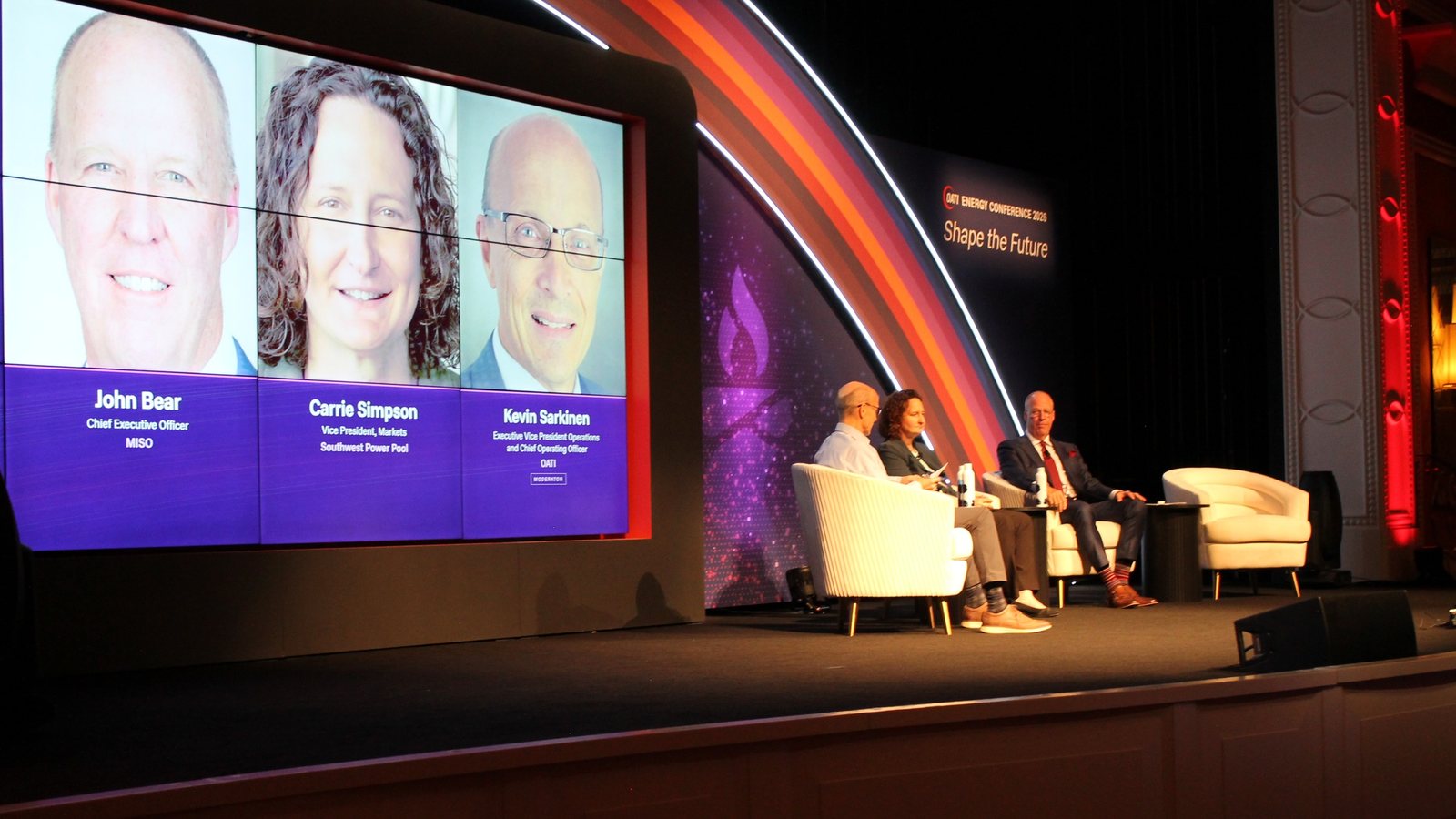
At EC26, Southwest Power Pool’s Carrie Simpson and MISO CEO John Bear described two neighboring markets rewriting interconnection rules, pricing and coordination as load growth returns.
For years, the two market operators in the middle of the country added wind, retired coal and adjusted at the margins. At the EC26 Executive Summit on October 6, the leaders of both said the pace has changed.
The panel, moderated by OATI Executive Vice President Operations and Chief Operating Officer Kevin Sarkinen, brought together Carrie Simpson, vice president of markets at Southwest Power Pool, and John Bear, CEO of MISO. Simpson opened with a reminder of how long the two organizations have worked alongside OATI: the first time she used an OATI product, she said, was in 1999, to build a tag.
A new shape to the day
Bear described a portfolio changing faster than the market rules built around it. MISO carries about 35 gigawatts of wind. “Three years ago we’re at about two gigawatts of solar. Today we’re at 20. And a year from now [we’ll] be at about 40,” he said.
That has reshaped prices across the day. Where MISO once saw a steady price with occasional peaks, daytime prices are now low and two or three evening hours spike, by design, to pull in the ramp needed when the sun sets. MISO moved to seasonal and marginal resource accreditation, sharpened its forecasting, and is studying the spread between daytime and evening prices to understand how batteries will charge and discharge.
One market across two interconnections
Simpson described two years of expansion at SPP. In April, SPP took over balancing in the West and began optimizing its RTO market across the DC ties between the Eastern and Western interconnections.
“We are now optimizing across DC ties, which is something no one has done in North America that I’m aware of.”
Carrie Simpson, Vice President, Markets, Southwest Power Pool
Watching the market decide which way the ties should flow has been “really interesting,” she said, and price separation between East and West has led SPP to study expanding the ties. Separately, SPP is building Markets+, a market designed for the West, which she said is slated to go live in October 2027.
Making room for large loads
Both operators rewrote their processes for large loads. Simpson said SPP found that almost all of its processes assumed organic load growth, until customers began asking for 500 megawatts or a gigawatt. SPP defined a high impact large load, generally 50 megawatts or more, and committed to telling a requester what interconnection will cost and require within 90 days, with options for loads that start non-firm, bring their own generation or respond to price. “We’re basically trying to get out of the way and enable folks to interconnect,” she said.
Large loads are not the whole story, she added. SPP peaks at about 55 gigawatts in summer, and expects 20 gigawatts of ordinary load growth over the next ten years, more than its 15 gigawatts of large load requests.
Bear said MISO worked through the same questions with SPP, then built a separate path for large loads that bring their own generation, studied one at a time with an answer in 90 to 100 days. MISO is also designing demand response products that would let a large load turn off on the worst day of a season. “If you’ve got one and a half to five gigawatt levers around your footprint you can pull as reliability coordinator, that’s a great way to sleep at night,” he said.
Coordination at the seams
SPP and MISO have run market-to-market coordination on congestion along their seam for more than a decade. When a weather system moves west to east, Simpson said, the operators talk ahead of it, and power moves in thousands of megawatts to whichever footprint is hit hardest. Bear said the two sometimes move 10,000 megawatts either way in the same day.
The West is different. SPP has spent months with the California ISO on how the two will coordinate, and filed a joint seams report with FERC. The first job, Simpson said, was learning each other’s vocabulary: “We may be actually saying the exact same thing, but we were using different words.”
Two years out
Asked what keeps him up at night, Bear pointed to the control room: solar, the evening ramp and gigawatt-scale loads in a single spot, with less time to react than ever.
“When you get inside the control room today, compared to the control room even ten years ago, you don’t have time and you can’t put enough people in there to do the computational work that you need to do.”
John Bear, CEO, MISO
The priority, he said, is tools that work together, with forecasting and the correlations between wind, solar and load good enough to show where trouble will rise before it does. Simpson named large loads, cost allocation that protects ordinary consumers, and a West that is still building its markets. “Lots of change coming there,” she said.
What it takes to give operators that time back is the subject of our white paper, AI in the Control Room.
Watch the full session
The complete Market Movements panel from the EC26 Executive Summit, with Carrie Simpson, John Bear and Kevin Sarkinen (41 minutes).
See the moments from the week, the keynotes and the 2026 Grid Intelligence Awards in the OATI Energy Conference 2026 recap.
Keep exploring
- SPP’s western expansion: the market behind the Market Innovation Award
- PacifiCorp enters the Extended Day-Ahead Market: how OATI supported PacifiCorp’s entry into EDAM in May 2026
- AI for Energy: where AI Genie™ fits across grid operations and markets
Save the date
OATI Energy Conference 2027
October 6-8, 2027, Encore Las Vegas