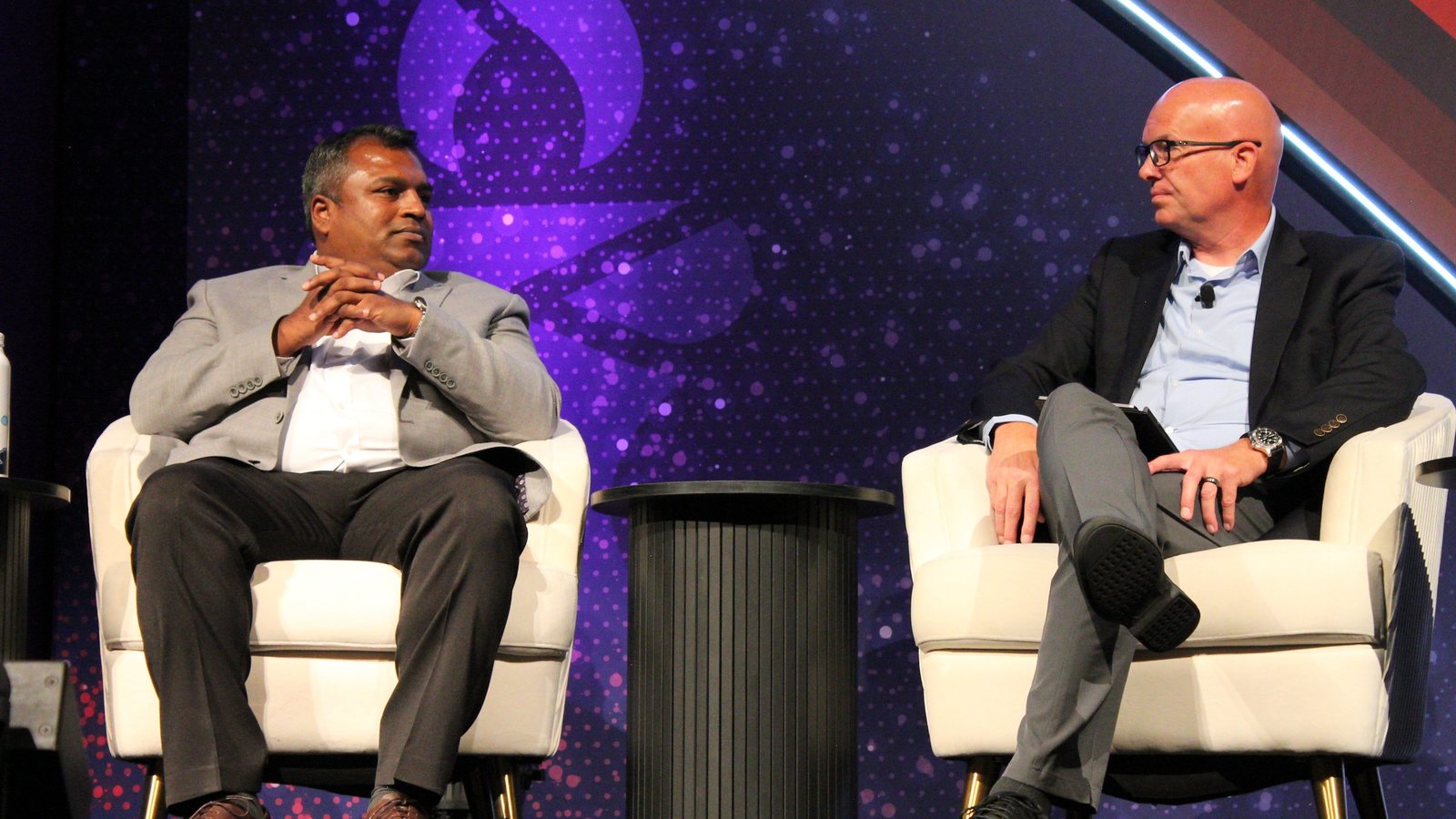
At the EC26 Executive Summit, leaders from Avangrid, Bonneville Power Administration and Landis+Gyr argued that the cheapest megawatt is often the one the grid already has.
Demand is growing faster than it has in a generation, and every utility board is asking the same questions. OATI EVP Jerry Dempsey put them to his panel in one breath at the opening of the EC26 Executive Summit on October 6:
“The issue is do you build it or do you flex around it. Who’s going to pay for it. What if you forecast wrong.”
Jerry Dempsey, EVP, OATI
Over the session, his panelists, from an independent power producer, a federal power marketing administration and a grid edge technology company, kept arriving at the same answer: build what has to be built, and get far more out of the system that already exists.
Forecasts are missing what the meters can see
Amith Kota, chief product and technology officer at Landis+Gyr, described load that no longer grows evenly. Hyperscale campuses arrive in hundreds of megawatts at a time, while smaller AI workloads spread into offices and commercial buildings. A forecast built for steady, organic growth tells a planner how much is needed, he said, not where or when it will show up.
“15 minute load profile data is not going to be enough,” Kota said. Utilities are asking for granularity fine enough to show patterns behind the meter, because the planning question has changed: “It’s not just about how much I need to build, but what do I need to build out.”
The lowest-cost megawatt
Kevin Dickey, senior director of energy management performance at Avangrid, spoke from a developer’s chair, and his first answer was not to build. “The lowest cost piece of infrastructure is the one that never has to be built,” he said, crediting regional markets, better forecasting and geographic diversity with unlocking flexibility already on the system.
“Affordability and flexibility go hand in hand. Not all megawatts anymore are created equal. There’s more value in a megawatt that comes with flexibility than there is [in] the old megawatt that we’re used to.”
Kevin Dickey, Senior Director, Energy Management Performance, Avangrid
He added that markets “price uncertainty faster than the planning process does,” and admitted that flexibility is the harder sell. “Sometimes it’s easier to sell the idea of putting new steel on the ground, or putting a new substation or a new transmission line, than it is to sell the concept of flexibility,” he said, because flexibility comes with an education process.
Protecting the customers who were already there
Michelle Manary, vice president of transmission marketing and sales at the Bonneville Power Administration, described a model with no investor to absorb a miss. Bonneville’s customers are largely smaller public utilities, and some fear being pushed aside by the rush to serve data centers. Her test is direct: “how do you keep rates the same as they would have been without the large loads.”
She also pointed at the way the industry is organized. “Traditionally you have your generation queue over here, you have your transmission queue over here, and you have your load queue over here,” she said. Those conversations now have to happen together, and flexibility has to come from every side. “It’s just not on the transmission service provider or the generator [or] load. We have to figure out those shared tools.”
Manary told the room that Bonneville is moving to new criteria and rate structures to bring large loads on quickly while showing existing ratepayers they are not harmed, and that the pace of the work is changing with it: “get it close, learn from others and fix it,” with reliability and safety first.
Flexibility as capacity
Kota offered the panel’s organizing idea. Utilities have built for peak, so capacity already exists in the grid, even if it is not always where it is needed. “We can’t build ourselves out of this,” he said. Extracting that capacity means new systems and new processes, with transmission, distribution and generation working together. “Flexibility as the capacity is going to be important.”
He also asked the room to change the vocabulary. Demand growth signals new industries and new jobs, he said, and the conversation should be about prosperity, not only affordability: “How do I actually extract more value out of the grid I’ve already built.”
One message for the board
Dempsey closed by asking each panelist for the single point they would put in front of a board. Kota described three legs of a stool: large customers served at the speed and scale they need, a grid used to the full extent it was built for, and consumers who can support the growth without their rates going up. Manary went back to fundamentals: be resource sufficient, come to the table as a partner, and plan for the tail events. “It’s now all about capacity,” she said.
“The flexible megawatt, whether it’s generation or load, has more value in 2026 and going forward than the inflexible megawatt.”
Kevin Dickey, Avangrid
Dickey added a second point. The companies that win from here, he said, “are the companies that are successful at the intersection of operations, of markets and of economics.”
See the moments from the week, the keynotes and the 2026 Grid Intelligence Awards in the OATI Energy Conference 2026 recap.
Keep exploring
- Getting more out of the grid: strategies for serving load growth
- AI for Energy: where AI Genie™ fits across grid operations and markets
- OATI AI Genie™: energy-native AI, already in the control room
Save the date
OATI Energy Conference 2027
October 6 to 8, 2027 · Encore Las Vegas