By Farrokh Albuyeh, Executive Vice President, OATI
Flexible interconnection, AI in the control room, and cooperative microgrid projects. The theme was consistent across all three OATI-led sessions: the demands facing the power grid have rapidly changed, and how we operate it must too. the grid is increasingly operated against dynamic limits, and the tooling has to keep up.
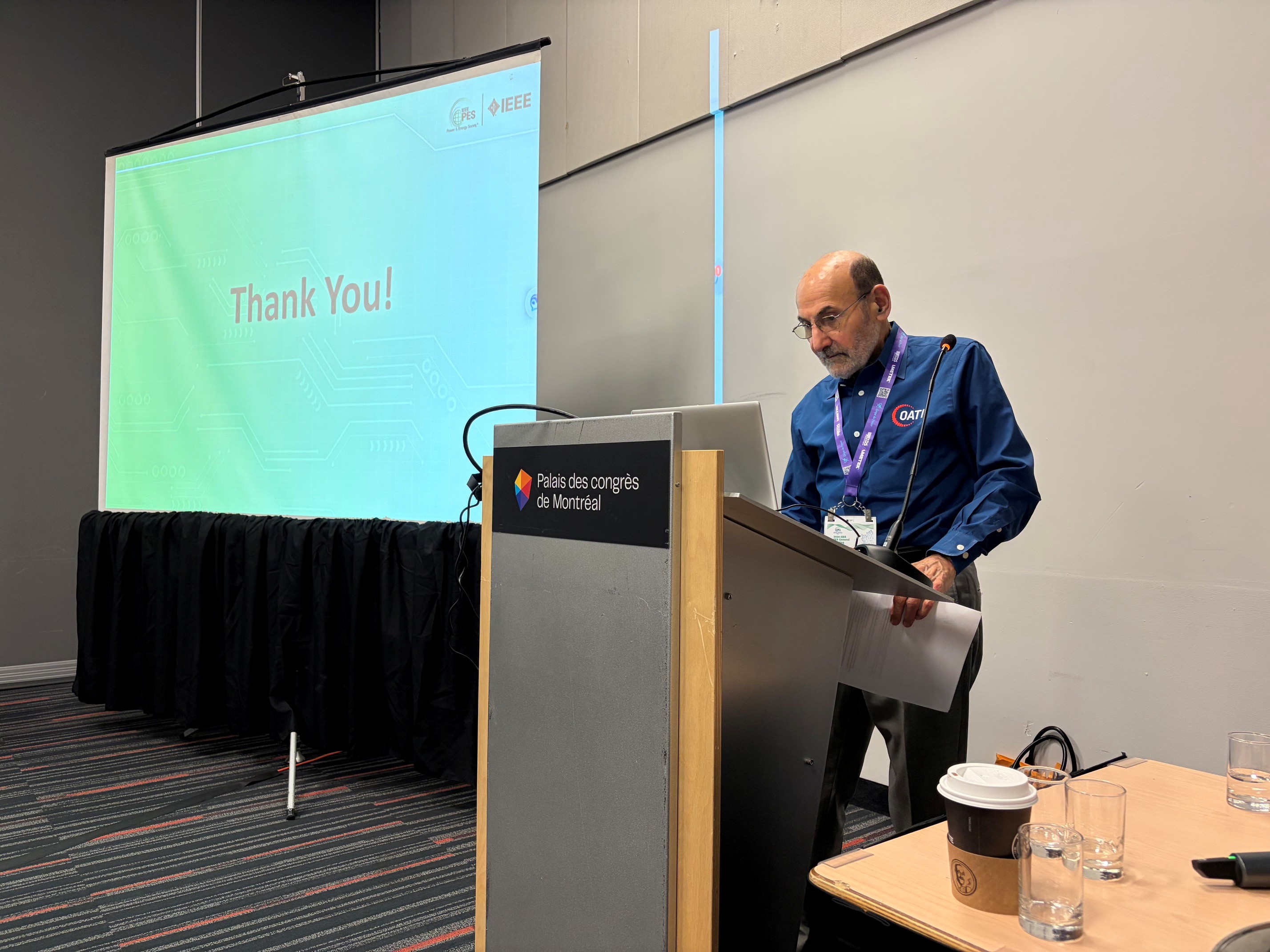
OATI supported three sessions at the 2026 IEEE Power & Energy Society General Meeting in Montreal. On the program they looked unrelated. In the rooms, they kept arriving at the same place.
Flexible interconnection for large loads
I was honored to join a distinguished panel that featured QGEMS Energy, Pacific Northwest National Laboratory, and the University of Pittsburgh. The premise: a firm interconnection promise, priced against worst-case hosting capacity, is a poor bargain when the new load is a data center that can move hundreds of megawatts inside a minute.
Dynamic operating envelopes replace that static promise with a time-varying limit computed in near-real time, enforced centrally or honored locally by the customer’s own controls. The Q&A pushed on every side of it — reliability, resilience, economics, and regulatory footing.
Field experience with generative and agentic AI
The AI panel brought deployment experience from OATI, the California ISO, Pacific Northwest National Laboratory, and EPRI on AI for energy and power grid operations. The distinction that mattered wasn’t generative versus agentic. It was general-purpose versus energy-native: a system built on operational grid data, aware of physical and market constraints, integrated with the systems of record, auditable line by line, and designed so the operator keeps final authority.
A general-purpose chatbot asked which outages affect COI may offer a certificate of insurance. An energy-native one returns the outages on the California-Oregon Intertie. CAISO’s AI-powered transmission and generation outage management work showed what that looks like at scale, where hundreds of new outage requests arrive daily and review has historically consumed dozens of analyst hours a day. Now, with support from OATI AI Genie™, operators are building these reports in around 8 minutes.
Utility-scale storage and microgrids: what the cooperatives have learned
In the Electric Cooperatives’ Experience in Building a Resilient Grid session, OATI’s Ebrahim Vaahedi presented project experience rather than architecture. Two themes carried the session.
First, delivery discipline. OATI GridMind® projects run a repeatable three-phase process: controls design and a written statement of objectives, then hardware build with asset modeling and factory acceptance testing, then site acceptance testing that exercises the full sequence of operations in every mode, followed by operator training. Sequences are proven first on a hardware-in-the-loop replica of the site, so changes are tested against a twin before they reach the live system. A controls contractor is with a utility for the life of the project, and the process is what makes that relationship predictable.
Second, where logic belongs. Anything acting on local site inputs and outputs stays in the local controller — feeder power factor correction, for example. Anything depending on conditions beyond the site belongs in the cloud, where a utility DERMS makes the call — dispatching storage to cut purchases from an upstream provider, for instance. That split is why software-defined control platforms and traditional automation controllers both appear in GridMind® sites: the software layer is configured rather than programmed, which keeps operations uniform across a fleet, while automation controllers handle the fast, deterministic loops they are good at.

The project examples made both points concrete. NCEMC and Wake Electric expanded the Eagle Chase system from a core microgrid to serve additional load segments, with each expansion validated in the lab first — background on that program is in the NCEMC real-time DERMS case study. At Rose Acre Farms, Tideland EMC built a feeder-level microgrid in functional phases — a DER site first, microgrid capability second — pairing a 2 MW solar array and a 2.5 MW / 5 MWh battery with 15 buildings and the customer’s own standby generation, with load shed and sequencing coordinated directly with the host.
Two lessons from the field were blunt enough to repeat. Choose the resources yourself: inverters and other power conversion devices will be on the system for twenty years or more, so vet both the equipment and the manufacturer who has to support it. And the most common way a project misses a goal is not a control failure — it is a misunderstanding of what a resource was capable of in the first place.
The thread
Static assumptions are the common failure across all three sessions: a fixed interconnection limit, a fixed operating procedure, a resource assumed rather than verified. Each session’s answer was to compute the limit closer to real time and put it where it can be acted on. That’s how we get more out of the grid without requiring new infrastructure.
Asked where microgrid optimization and controls go next, Vaahedi expected AI to start higher in the stack — at the DERMS layer, where some utilities are already using it to support decisions — and move down as the problems below get harder. That is the same direction the AI panel described from the transmission side. For where to begin, see the critical path: AI for energy, where should we start.