Unify distributed energy resources with DERMS.
Stage 3: The utility DERMS journey
At this stage of the DERMS journey, your utility likely has a DERMS in place to manage various grid edge programs. Maybe more than one. These siloed systems have become difficult to organize and orchestrate, and your departments aren’t working off the same data flows. In order to scale and improve operational efficiency, you need to bring these systems under one umbrella.
The true strength of OATI’s enterprise DERMS is in the integration layer, where IT and OT data and workflows build off each other.
STAGE 3
Coordinate & scale
DERs with DERMS

The decision is made and the rollout is underway. Now the hard part: integrating DERMS with the systems you already run, and avoiding the friction that stalls deployments.
These resources focus on the integration layer, showing how DERMS and ADMS work as one coordinated view, how another utility navigated its own rollout, and where storage fits into the broader picture.
What to focus on now: integration, coordination, and learning from utilities a few steps ahead of you.
For program managers: You have programs. Now you need a platform.
You’ve stood up real programs— maybe a storage pilot, a managed-charging initiative, a demand response tool, even a DERMS or two. Individually, they work. Together, they’re a patchwork: separate vendors, separate integrations, separate teams, and no clean way to scale any of them enterprise-wide.
The job now isn’t proving DERs can be managed— you’ve already done that. It’s consolidating what you’ve built onto one modular platform so you can add resources and use cases without standing up another silo every time. The focus at this stage is what unification actually takes: migrating existing programs, integrating with the systems you already run, and moving from a handful of initiatives to an enterprise DER strategy.
For operators: One grid, one view.
Right now your operators may be watching distributed resources through several disconnected tools, each with its own interface and its own blind spots. That fragmentation is tolerable at pilot scale and genuinely risky as programs grow.
Unifying DER management gives the control room a single coordinated picture — DERs, DERMS, and ADMS working together — so operators can see and dispatch the whole distributed fleet from one place instead of assembling the picture in their heads. The emphasis here is the operational integration that makes scaling safe rather than chaotic.
For market teams: Fragmented programs can’t bid as one portfolio.
When each program lives in its own tool, your DERs can’t act as a single coordinated market asset, and that caps how much value you can capture. To scale participation, storage, EV, solar, and demand-side resources need to aggregate across programs into unified, market-eligible portfolios with consistent telemetry and settlement.
Unifying onto one platform is what turns a collection of pilots into a virtual power plant that can actually compete at scale. The content here covers how consolidation unlocks the aggregation and reach your market strategy depends on.
For executives: Turning scattered pilots into an enterprise asset.
Your teams have proven DERs can be managed, but a portfolio of disconnected programs isn’t a scalable strategy, and it isn’t delivering enterprise value. The inflection point is consolidation: moving from a patchwork of point solutions to a unified, modular platform that scales across every DER program and grows with your system.
That’s the difference between a set of successful experiments and a distributed energy strategy the business can actually build on. The framing here is why unification is the prerequisite for scale, and for the returns the board is looking for.
Resources for this stage
of the DERMS journey

DERMS and ADMS: Dynamic and integrated utility controls
Request the white paper to learn more about how a properly designed DERMS addresses both grid reliability operations as well as the commercial aspects of dealing with DERs and the associated transactions with customers and other third-party DER asset owners.
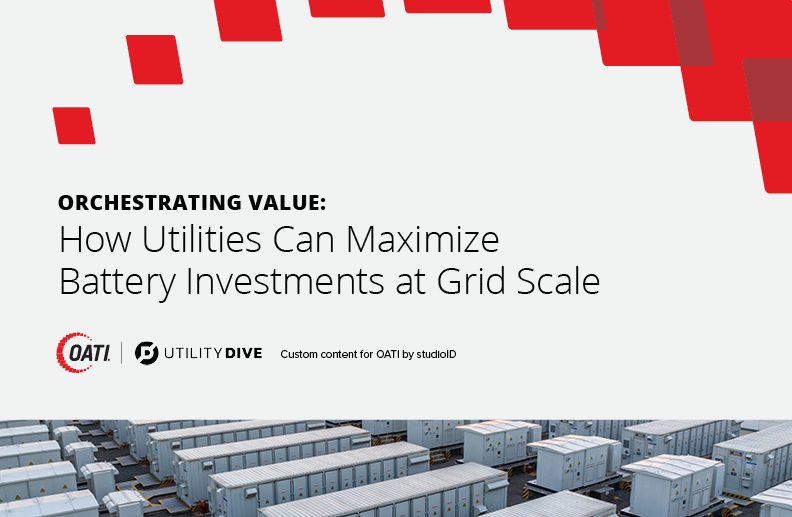
Battery storage investment playbook
This playbook outlines how modern grid orchestration can unlock the full potential of utility-scale batteries and support a more resilient, flexible and economically optimized grid.
Utility leaders share real-world examples and proven strategies for delivering enhanced grid reliability, operational savings and revenue opportunities in utility-scale battery adoption.

Why cooperative utilities are flocking to DERMS
Out of the ~60 G&Ts serving rural communities in the U.S., 11 have adopted OATI DERMS, a number that expands to more than 220 rural electric cooperatives when including their member cooperatives, and that’s no coincidence.
Customer spotlight: OG&E
Oklahoma Gas & Electric had a vision for innovation that required a robust DERMS. But the business cases of today don’t always match those to come. OATI DERMS offered the modularity to get started and grow.