Generative and Agentic AI in Grid Operations: Field Lessons from OATI, CAISO, PNNL, and EPRI
Insights from the “Field Experience with Generative and Agentic AI for Electricity Grid” panel at the 2026 IEEE Power & Energy Society General Meeting.
The electricity grid is being asked to do something it was never designed for: absorb thousands of intermittent renewable and distributed energy resources, serve enormous new loads like data centers, and stay reliable through volatility that shifts minute to minute. Grid operators are managing more data, more scenarios, and a faster pace of change—often with less institutional experience to draw on than the operators who came before them.
Artificial intelligence is the obvious candidate to close that gap. But in an industry where a single wrong recommendation can cascade into an outage, the question that matters isn’t whether generative and agentic AI could help. It’s what is actually running in a control room today, what it’s delivering, and what the teams deploying it have learned.
That was the focus when OATI convened a panel of practitioners at the 2026 IEEE Power & Energy Society (PES) General Meeting in Montreal. Moderated by OATI Executive Vice President Dr. Farrokh Rahimi, “Field Experience with Generative and Agentic AI for Electricity Grid” brought together real deployment experience from OATI, the California ISO (CAISO), Pacific Northwest National Laboratory (PNNL), and the Electric Power Research Institute (EPRI).
This article distills what was shared: how energy-native AI differs from general-purpose tools, three deployments moving from pilot to production, the cross-cutting lessons emerging across the industry, and the hard questions operators are still asking.
Why the grid needs a new kind of intelligence
Any discussion about AI in energy must be grounded by the realities facing power grid operators. As EPRI’s Vikas Singhvi framed it, operators today face more data to manage and more scenarios to weigh, frequently with less experience handling novel conditions, all under greater complexity and a higher pace of change. Their job has always been to make sense of alarms, trends, weather, oscillations, and prices; make decisions based on forecasts, simulations, and risk assessment; and take action by switching, dispatching, and reporting. What has changed is the sheer volume and velocity of everything feeding those three steps.
Conventional, physics-based power system tools remain essential, but they were built for a more predictable grid. They struggle to keep pace with a data-heavy, volatile landscape shaped by high renewable penetration, behind-the-meter resources, and demand-side complexity. The result is a widening gap between the information available to an operator and the time they have to act on it.
Generative and agentic AI is compelling precisely because it targets that gap—not by replacing the operator or the physics, but by distilling overwhelming data streams into context an operator can act on in the moment.
From generative to agentic: what “energy-native AI” actually means
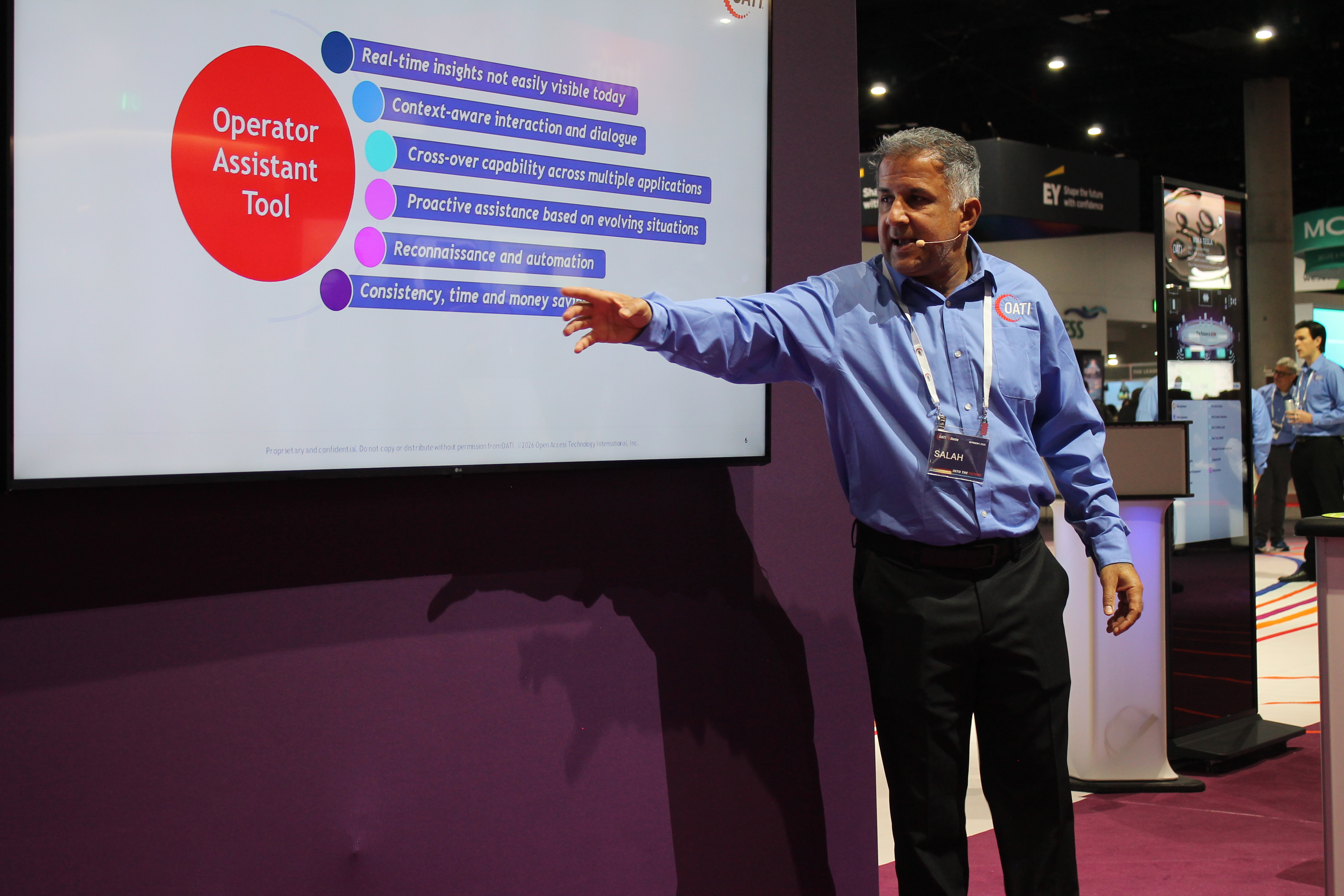
To ground the conversation, OATI Senior Vice President Salah Khuhro walked through the AI landscape as a set of nested capabilities: artificial intelligence (machines simulating human intelligence), machine learning (systems that learn from data without explicit programming), deep learning (multi-layered neural networks), generative AI (using deep learning to create new content), and agentic AI (using generative AI to act independently toward a goal).
The distinction that matters most for the grid, though, isn’t generative versus agentic. It’s general-purpose versus energy-native.
Khuhro illustrated the difference with a deceptively simple question: “Which outages impact COI?” A general-purpose chatbot might read “COI” as a certificate of insurance, or ask whether you meant “coil.” An energy-native system knows COI means the California-Oregon Intertie and returns the outages that actually affect it. That’s the difference between a tool an operator can trust and one they have to second-guess.
Energy-native AI, as OATI defines it, is built from the ground up for the industry it serves. Five characteristics set it apart:
- Built on operational grid data—not generic web text.
- Aware of physical and market constraints, so its outputs respect how the grid and markets actually behave.
- Integrated with systems of record, so it works inside the operator’s existing environment.
- Auditable, so every answer can be traced and explained.
- Human-in-the-loop by design, so the operator keeps final authority.
Those five traits recurred, in different words, in every deployment the panel discussed.
Field experience: three deployments, one direction of travel
The heart of the panel wasn’t a vision of the future. It was three teams reporting what they have actually built.
CAISO: multi-agent AI in production for outage management
The California ISO brought the most direct answer to “what’s running today.” Presented by Gopakumar Gopinathan, CAISO’s work shows generative and agentic AI moving from experiment to daily operational use.
Start with the scale of the problem. As the Reliability Coordinator for much of the Western U.S., CAISO’s RC West footprint processes more than 500 new generation outage requests and 200 new transmission outage requests every day, with roughly 3,000 outages active at any given time. Reviewing them consumes on the order of 40 hours of analyst time across teams per outage day. Every request moves through a multi-stage lifecycle, from long-range planning 90 to 120 days out, all the way to real-time. By the time it reaches real-time, it must be fully prepared, with every attribute present and all modeling checked. Upstream consistency is what makes that possible.
To meet that load, OATI, in collaboration with CAISO, built a multi-agent AI Genie™ architecture that is now live in a production environment. Rather than one monolithic model, it orchestrates specialized agents around the outage review workflow:
- A Workflow Agent that generates nightly analysis reports, automatically reviewing the day’s outages across the fleet with anomaly flags and context.
- An Advisor Agent that answers questions over operating procedures and historical data, with citations—retrieval-augmented reasoning on demand.
- A Recon Agent that continuously monitors critical outages and alerts on emerging reliability concerns as conditions change.
- Autonomous agents that combine analysis, monitoring, and advisory functions, triggered by events or by the orchestrator.
Reviewers meet the platform through three interfaces: a conversational chatbot, automated nightly analysis reports, and a geospatial dashboard with balancing-authority capacity-margin overlays, so the AI shows up where they already work within the generation and transmission outage management system provided from OATI. Critically, the agents share context through a common orchestrator, and reviewers retain final authority, always seeing the evidence behind every recommendation.
How does AI Genie work?
Learn more about OATI AI Genie and our collaboration with the California ISO in a recent episode of Threads of Connectivity, a documentary series distributed by NatGeo.
The results CAISO reported are concrete. The platform analyzes 500-plus next-day outage requests in under eight minutes each night—modeling and market-impact checks, historical comparison, and keyword analysis—before reviewers start their day. Procedure lookups and single-line-diagram lookups that once took minutes now take seconds. And a balancing-authority capacity-margin view that simply did not exist before is now live, giving RC operators at-a-glance situational awareness.
CAISO framed its AI approach as a three-tier strategy—Embed, Specialize, Customize—that other utilities and power grid operators can learn from. Embed means governed, low-risk AI for staff productivity and knowledge access. Specialize means AI grounded in operational data and woven into existing tools to improve decision support. Customize means bespoke models and agents built on the ISO’s own data and workflows for lasting advantage. Each tier builds on the one before it.
Looking ahead, CAISO is also exploring time-series foundation models to forecast capacity margins across every balancing authority in the RC West footprint—a multi-signal, multi-horizon problem spanning generation and transmission outages, interchange, renewable penetration, weather, and demand-side complexity. It is early, deliberately benchmarked against classical baselines, and being validated carefully before any conclusions are drawn.
PNNL: a standards-based data mesh for trustworthy agents
If CAISO showed what production AI looks like, Pacific Northwest National Laboratory’s Dr. Alex Anderson addressed the foundational data layer that makes it trustworthy..
Large language models are versatile and strong at coding, with broad general knowledge of power systems but they have a limited grasp of formal modeling concepts, will hallucinate non-existent data classes, and may ignore instructions (returning the wrong query language, for example). Consistent, reliable retrieval and reasoning, PNNL argued, requires structured data and disciplined agentic tool chains.
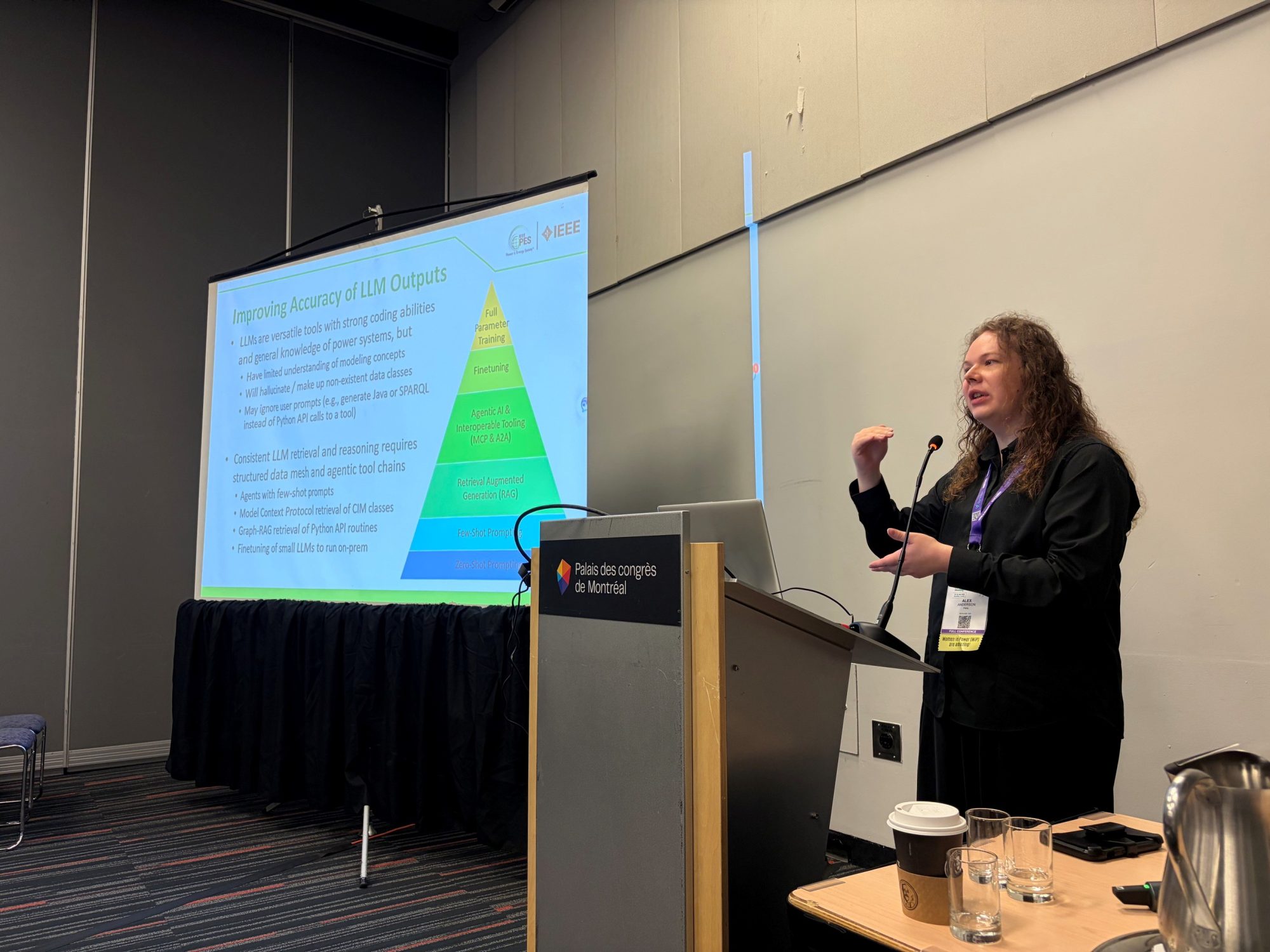
PNNL’s answer centers on the Common Information Model (CIM)—an open, standards-based vocabulary, published under Apache 2.0 by the CIM Users’ Group, for describing power system data. Used as the backbone of a “data mesh,” CIM enables a single source of truth spanning equipment, topology, dynamics, and SCADA data, and avoids the duplication of models and interfaces that otherwise plagues utility integration. Importantly, CIM is a vocabulary for data exchange.
On top of that foundation, PNNL described an architecture where reasoning agents access grid data through a medallion-tiered data mesh, call traditional power-flow solvers through the Model Context Protocol (MCP), and coordinate with one another through agent-to-agent (A2A) protocols. The design lets an agent follow the same logical steps a human operator would under the recognition-primed decision model: checking for branch overloads or voltage violations, identifying transfer paths, checking reactive limits and generator setpoints, and re-running contingency analysis on a recommended action.
Two themes from PNNL deserve emphasis because they echo across the whole industry. First, data governance is not optional: real-time agents need guaranteed data freshness and quality, because stale or ungoverned data leads directly to hallucinations, invalid answers, and potentially cascading failures. Second, compliance is a first-class requirement: PNNL pointed to demonstrated approaches for building NERC CIP-compliant, cloud-based control-room applications, with further work planned to support high-speed and third-party data streams.
EPRI: a shared vision for the control room of the future
EPRI’s Vikas Singhvi placed these deployments in a broader industry context, and in a collaborative effort to move the whole sector forward responsibly.
EPRI’s “Control Room of the Future” vision maps AI onto the operator’s fundamental loop: sense-making (making sense of alarms, trends, forecasts, and outages), decision-making (weighing options, risks, and benefits against processes and procedures), and action-taking (generation dispatch, switching, emergency and restoration), all with a human in the loop and manual control authority preserved.
Singhvi also drew a useful line between AI for process automation—using language models to automate reports, plans, and technical studies—and AI for decision support—using machine learning and generative AI to sense patterns and suggest actions. Both are valuable but conflating them is a common source of failed expectations.
Much of EPRI’s work runs through OpenPowerAI, a collaborative initiative bringing utilities and technology providers together to gather and prioritize use cases, demonstrate new capabilities, and develop control-room tools for sensing, decision-making, and action-taking. A question EPRI is tackling head-on—can AI be used safely with grid operational data and alarms?—is being explored through applications that keep operational data securely segregated from the model, use by-design guardrails to prevent hallucination, and can be deployed on-premises with open-weight models when no external connection is acceptable.
What the field is teaching us
Across four organizations and very different technical approaches, a strikingly consistent set of lessons emerged. CAISO distilled six from its own deployment.
Start with the problem, and stay with it
The deployments that work anchor each use case in a measurable operator pain point—reviewing 500 outages a night with AI Genie™, finding a procedure in seconds—rather than starting from a fascination with the technology.
Governance is the foundation
Every panelist who touched data made the same point: investment in data lineage, quality, and standardization pays back across every downstream AI project.
Human-in-the-loop is a feature
Trust is earned through transparency, citations, and operator override. AI Genie™ doesn’t remove the operator; it makes the operator faster and better-informed while preserving final authority.
Both AI paradigms matter
CAISO drew a helpful distinction between AI that helps you build and AI that drives the workflow. The former makes teams faster while the latter changes the application.
Adoption is the milestone that matters
Getting a model 80 percent of the way to useful is the easy part; refining the last 20 percent for production is where the real work lives. The deployments worth talking about are the ones operators use every day, where that daily feedback drives the roadmap.
The industry’s hardest questions, answered
The 40-minute Q&A surfaced the concerns that keep utility leaders up at night.
How do you get risk-averse operators to trust an AI “black box” over the physics-based models they know?
Trust is built by keeping the human in the loop, showing the evidence and citations behind every recommendation, and letting operators override the system. Energy-native platforms like Genie AI™ are designed to be auditable and to complement physics-based tools rather than replace them. Agents can even re-run traditional contingency analysis to validate their own recommendations.
How do you reassure executives that sensitive operational data won’t leak?
Approaches shared on the panel keep operational data securely segregated from the model, enforce data residency and validation, and support on-premises deployment with open-weight models when no external connection is acceptable. NERC CIP compliance is treated as a design requirement from the start, with demonstrated pathways for building compliant cloud-based applications. For OATI, Genie AI™, like all of the company’s applications, exists solely on OATI’s privately owned, operated and NERC CIP compliant data center network.
What will the energy AI landscape look like a year from now?
Expect the center of gravity to keep shifting—from pilots to production, from single models to orchestrated multi-agent systems, and from general-purpose tools to energy-native platforms grounded in operational data. Time-series foundation models for forecasting, standards-based data meshes, and reusable multi-agent patterns are all early today but advancing quickly. Each successful deployment lowers the cost of the next.
How do you test for false negatives—cases where a model misses a critical event?
The panel emphasized benchmarking AI outputs against classical methods before drawing conclusions, validating per use case and per balancing authority rather than assuming results transfer, and keeping humans in the loop precisely so a missed signal has a second line of defense. Calibration has to be earned, not presumed.
How do you build a proper feedback loop, and does the model update in real time?
The durable pattern is human-in-the-loop feedback driving the roadmap: operators’ daily use surfaces where the system needs to improve. That is deliberately distinct from continuously retraining a model against live grid state. In a control room, governance, reproducibility, and validation matter far too much to update a model blindly in real time.
Where OATI’s AI Genie™ fits
The through-line of the panel is also OATI’s thesis: the grid doesn’t need general-purpose AI bolted on—it needs energy-native, multi-agent intelligence built on operational data, aware of grid and market constraints, auditable, and designed to keep the operator in command.
That is what OATI AI Genie™ is built to be, and CAISO’s deployment is evidence it works in the environment that matters most: a live control room, in production. The same architecture proving itself in outage management—specialized agents, a shared orchestrator, human-in-the-loop authority, and results measured in minutes saved and situational awareness gained—is the foundation OATI is extending across grid and market operations.
The industry’s own field lessons point in one direction. Start with the operator’s real problem. Build on governed data. Keep the human in the loop. Ship something operators use every day. AI Genie™ is OATI’s answer to all four.