AI for Transmission and Generation Outage Management
Every generator and transmission line that comes out of service has to be reviewed, modeled, and cleared so the grid stays reliable while it is gone. Do it well and no one notices. Miss something, like a blank attribute or an alert, and the consequences show up in real time.
At the scale of a modern balancing authority or reliability coordinator, outage coordination has quietly become a data problem that outpaces human capacity. This article looks at why, what effective AI support actually looks like, and how one operator—the California ISO, working with OATI on the AI Genie™ platform—is putting generative and agentic AI to work in daily outage review. It is a companion to our overview of generative and agentic AI in grid operations. You can also learn more about our collaboration with the California ISO in a recent episode of Threads of Connectivity, a documentary series distributed by NatGeo.
The outage coordination problem, by the numbers
The California ISO offers a useful reference point because its scale makes the challenge concrete. As Reliability Coordinator for much of the Western U.S., its RC West footprint sees more than 500 new generation outage requests and more than 200 new transmission outage requests every single day, with roughly 3,000 outages active at any given moment.
Reviewing that volume consumes on the order of 40 hours of analyst time across teams for a single outage day. That is not a backlog that can be cleared with overtime; it is a structural mismatch between the volume of requests and the number of experienced reviewers available to assess them. And the work cannot simply be rushed, because outage review is not a one-time approval—it is a lifecycle.
Why outage review is a lifecycle, not a checkbox
Each outage request moves through a multi-stage review process, with the horizon shrinking at every step:
- Long-Range — 90 to 120 days out
- Mid-Range — 45 to 75 days out
- Short-Range — 7 to 14 days out
- Operational Planning Analysis (OPA) — 1 to 5 days out
- Day-Ahead — 1 day out
- Real-Time — the day of
Along the way, a single request may be reviewed by Operations Engineering–Planning, Reliability and Market Operations Engineering, the Transmission Desk, the Generation Desk, and the RC Desk. By the time it reaches real time, it has to be fully prepared: every attribute present, all modeling checked.
That is the crux of the problem. Real-time readiness depends on upstream consistency, and dozens of reviewers, across multiple desks must be working from the same facts and reaching compatible conclusions. When context gets lost between stages, or a reviewer misses a precedent buried in months of history, the error surfaces late.
What good AI support looks like in outage review
The instinctive fear is that AI will try to automate the reviewer out of the loop. The approach that works does the opposite: it hands the reviewer better raw material and keeps them firmly in charge.
In practice, that means surfacing four things inside the reviewer’s existing tools rather than a new, separate application:
- Summaries that distill a request and its history into something a reviewer can absorb quickly.
- Anomalies flagged automatically.
- Procedure citations so the relevant operating procedure is one click away, not a memory test.
- Precedent on the similar outages that came before, and how they were handled.
The design principle underneath all four is simple: meet reviewers where they work, and let the human keep final authority over every decision. AI that forces a new interface or asks operators to trust an unexplained answer adds friction exactly where the industry has the least tolerance for it.
The multi-agent approach: a case study in production
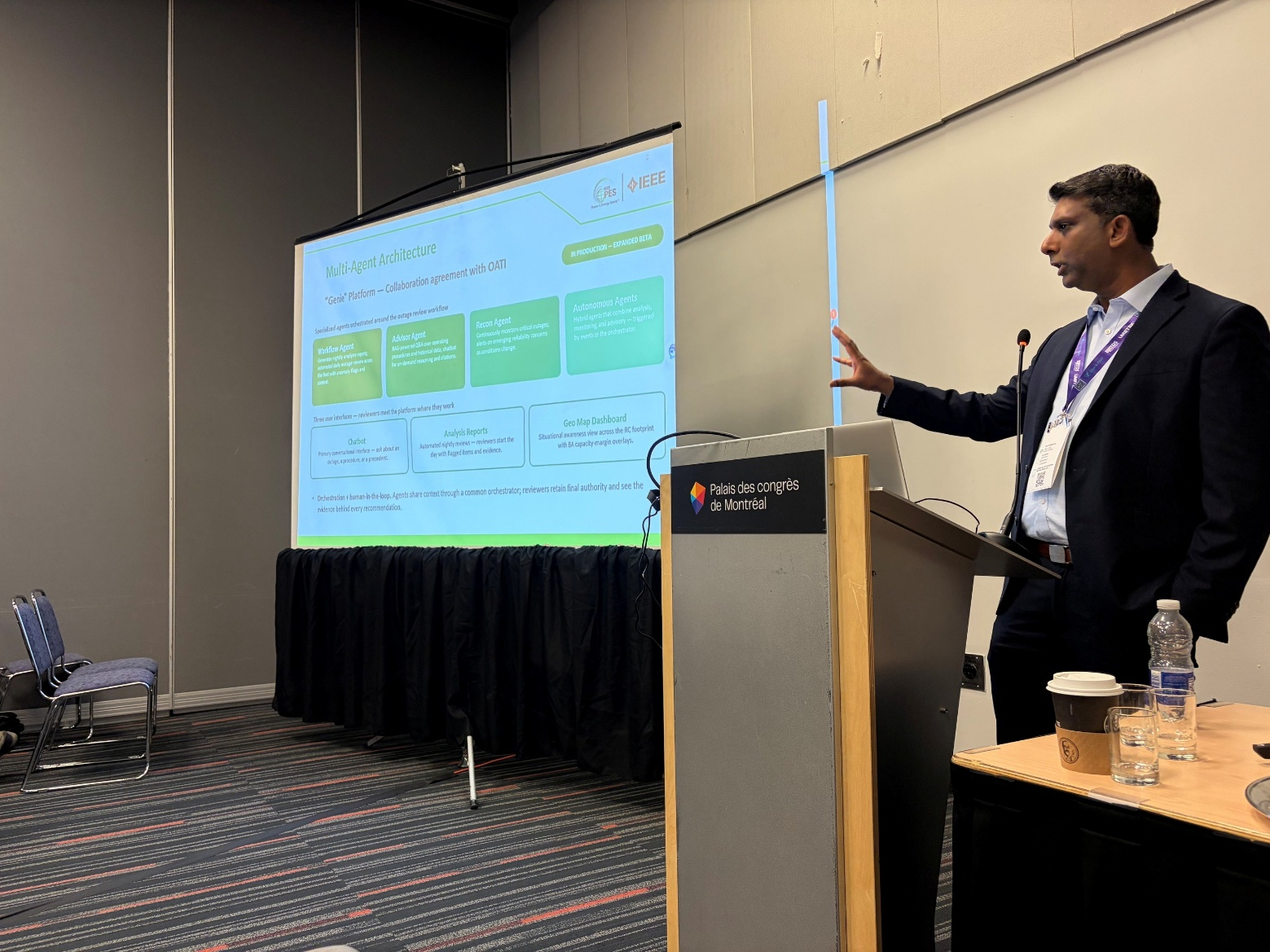
Meeting that bar is hard for a single, monolithic model. The California ISO’s answer—OATI’s AI Genie™ platform, built in collaboration with the grid operator and now running in production—instead orchestrates a set of specialized agents around the outage review workflow:
- A Workflow Agent generates nightly analysis reports, automatically reviewing the day’s outages across the fleet with anomaly flags and context.
- An Advisor Agent answers questions over operating procedures and historical data, returning citations—retrieval-augmented reasoning on demand.
- A Recon Agent continuously monitors critical outages and raises alerts as reliability conditions change.
- Autonomous agents combine analysis, monitoring, and advisory functions, triggered by events or by the orchestrator.
Reviewers reach the platform through three interfaces: 1) a conversational chatbot for asking about an outage, a procedure, or a precedent; 2) automated nightly analysis reports so the day starts with flagged items and evidence; and 3) a geospatial dashboard with balancing-authority capacity-margin overlays for situational awareness. A shared orchestrator lets the agents pass context to one another, and reviewers see the evidence behind every recommendation before acting on it.
The results
The payoff shows up in time and in coverage. The platform analyzes 500-plus next-day outage requests in under eight minutes each night—running modeling and market-impact checks, historical comparison, and keyword analysis before reviewers arrive. Procedure lookups and single-line-diagram lookups that used to take minutes now take seconds. And a balancing-authority capacity-margin view that did not exist before is now live, giving reliability operators an at-a-glance read on where the margins are tight.
The part vendors do not demo: the last 20 percent
One of the most useful lessons from the deployment is candid about where this work gets hard. As Gopakumar Gopinathan, CAISO’s senior advisor of power systems technology, shared at IEEE PES GM 2026, getting a system to 80 percent of useful is the easy part; the remaining 20 percent—hardening it for daily production—is where the real effort lives. Two failure points stand out:
- Legacy database schemas. The hardest problems are rarely the AI itself—they are data-structure complexity, made harder when the system has to build on top of existing architecture.
- Prompt ambiguity at the front door. The orchestrator and intent classifier have to route each request to the right agents. Get that wrong and everything downstream looks wrong, no matter how good the individual agents are.
For anyone evaluating outage management AI, that is the tell: the polished demo is not the hard part. The questions worth asking are about the last 20 percent.
Evaluating outage-management AI: a buyer’s checklist
If your team is weighing a generative or agentic AI capability for outage coordination, these questions separate a durable platform from a promising demo:
- Does it work inside reviewers’ existing tools, or bolt on a separate interface they have to remember to open?
- Does it show its evidence—citations, precedent, the reasoning behind a flag—or just hand over an answer?
- Does the reviewer keep final authority, with the ability to see and override every recommendation?
- Is it grounded in your operational data and models, or is it a general-purpose tool guessing at your grid?
- Can it handle your legacy data architecture—the schemas and integrations you actually run, not an idealized one?
- Is the intent routing reliable? Ask how the orchestrator decides which agent handles a request.
- Is it proven in production, used daily by operators, or still a pilot looking for its first real workload?
Where OATI’s AI Genie™ fits
AI Genie™ is the platform behind the California ISO deployment described here: energy-native, multi-agent, and already in production in a live control room. It was built for exactly the conditions outage coordination demands to support CAISO’s existing outage management system from OATI—grounded in operational grid data, aware of grid and market constraints, auditable, and designed to keep the human reviewer in command.
The same architecture proving itself in outage review is the foundation OATI is extending across grid and market operations. If outage coordination is straining your team, the field-tested answer is not a smarter chatbot—it is a multi-agent platform that makes your reviewers faster while keeping them in charge.