How to unite and coordinate DERs with DERMS
By Ali Ipakchi, Chief Visionary Officer, OATI & John Engel, Assoc. VP of Digital Strategy & Strategic Innovation
Somewhere between your first battery energy storage pilot and your third distributed energy program, operational realities begin to hit. What began as a handful of manageable initiatives becomes a web of tools, vendors, and integrations that no longer add up to a strategy. The individual programs still work, but they stall when it comes time to scale.
If your utility has a few edge programs running, maybe a distributed energy resource management system (DERMS) or two already in place, and a growing sense that adding the next DER program means adding the next silo, you’ve reached the inflection point that separates utilities experimenting with DERs from utilities operating them as a coordinated fleet.
At OATI, we see the dynamic all the time. OATI DERMS is the utility industry’s most-deployed smart grid platform because of its ability to unite disparate DER programs, seamlessly integrate with legacy utility systems, and supports both traditional DR programs and advanced grid‑reliability functions — balancing energy, ancillary services, voltage support, feeder‑level load management, and real‑time operational performance.
Take the DERMS journey.
You’re early in the journey, and the DERMS software landscape is noisy. Every vendor defines DERMS a little differently, and it’s hard to tell foundational capabilities from features you’ll never use.
You know what DERMS is — now you need to know whose actually works. You’re comparing platforms, weighing vendors, and trying to separate polished demos from production reality. This is where claims meet evidence.
The decision is made and the rollout is underway. Now the hard part: integrating DERMS with the systems you already run, and avoiding the friction that stalls deployments.
Going enterprise means consolidating data streams and workflows to ensure all departments are looking at one grid. It’s a job only an enterprise DERMS can do.
Organizing a DER patchwork
No one sets out to build a fragmented DER operation, but it’s a common reality for utilities large and small.
Oftentimes, fragmentation is the result of the utility’s organizational model—different departments have defined budgets and procurement processes, leading them to acquire the tool that best fits their own use case at the time. That’s by no means an indictment of the utility or its management teams. However, as DER programs scale, the platforms responsible for managing them must work in lockstep in order to ensure data accuracy and operational alignment, and maximize revenues.
Fragmentation is a scaling wall
Fragmentation is tolerable at pilot scale. It becomes a wall the moment you try to grow.
The costs are rarely obvious on any single program’s balance sheet, because they live in the seams between siloed departments. Every new resource means another point integration to build and maintain. Telemetry and data standards differ from tool to tool, so nothing aggregates cleanly. Your market team can’t bid distributed resources as a single coordinated portfolio, which caps the value those resources can earn. And in the control room, real-time operators end up watching the distributed grid through several dashboards at once, assembling a coherent picture in their heads because no system does it for them.
Individually, these are annoyances. Together, they are the reason DER programs plateau.
You can’t scale what you can’t see, coordinate, or grow without rebuilding it each time.
Unify your DER programs
The instinct at this point is to fear a rip-and-replace: tearing out working programs to start over on a single platform. That’s the wrong model, and it isn’t what unification requires.
A modular enterprise DERMS is designed to consolidate what you’ve already built rather than discard it. Existing programs migrate onto a common platform. New resource types plug into the same framework instead of spawning new silos. And critically, the platform integrates with the systems that actually run your utility — ADMS, GIS, AMI, MDM, and CIS — so distributed resources become part of your grid operations rather than a parallel universe beside them.
The point isn’t to own one tool for its own sake. It’s to have one coordinated foundation every DER program can build on, so growth stops multiplying complexity.
What unification unlocks
When fragmented programs come together on a unified platform, the payoff shows up differently for every part of the utility.
Operators get a single coordinated view of the distributed fleet — DERs, DERMS, and ADMS working as one— instead of a wall of disconnected screens. Dispatch decisions are made based on a single source of truth.
Market teams can finally aggregate storage, EV, solar, and demand-side resources across programs into unified, market-eligible portfolios. A collection of pilots becomes a virtual power plant with the scale to compete.
Program managers stop re-integrating with every addition. Bringing on the next resource or use case becomes a configuration, not a project.
And for executives, the scattered experiments consolidate into an actionable solution to rapid load growth: an enterprise DER strategy with visible, scalable returns without the need for costly, slow infrastructure builds.
Is your DERMS part of the problem?
The utilities pulling ahead on DER rollout and optimization aren’t necessarily the ones that started earliest or assembled the perfect tech stack from the beginning. They’re the ones that recognized a specific inflection point — the moment a portfolio of successful programs needs to become a single, scalable system — and moved to unify before fragmentation capped their growth.
If that’s where your utility is now, the next step isn’t another point solution. It’s a platform built to bring what you already have together, and to scale with whatever comes next.
OATI’s enterprise DERMS is modular by design — and the industry’s most-deployed smart grid platform — built to unite fragmented DER programs and existing systems into one foundation you can scale. Reach out to talk through what unification would look like for your utility.
Resources to keep your
DERMS journey on track.
Short-term load growth strategies
Our short-term load growth whitepaper looks at digital strategies for maximizing output from existing distributed energy resources as demand from data center development, industrial manufacturing, and broader electrification rises sharply.

What are the different types of utility DERMS?
What separates aggregator and grid-edge DERMS from grid DERMS, and what does enterprise DERMS really mean in practice.
OATI created the first DERMS in 2009 and has been the market leader ever since.
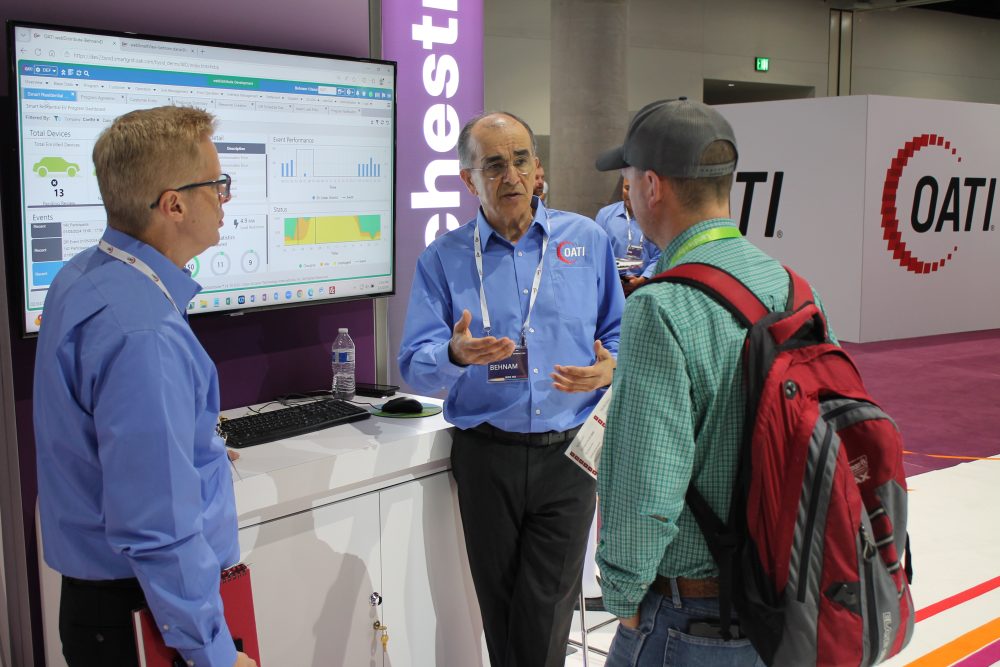
Utility DERMS in action
Utility leaders face a pivotal moment: balancing grid reliability, distributed resource integration, and modernization. But finding proven, verifiable DERMS case studies can be challenging in a murky vendor pool.
Battery storage investment playbook
This playbook outlines how modern grid orchestration can unlock the full potential of utility-scale batteries and support a more resilient, flexible and economically optimized grid. Utility leaders share real-world examples and proven strategies for delivering enhanced grid reliability, operational savings and revenue opportunities in utility-scale battery adoption.
OATI DERMS Datasheet
OATI webSmartEnergy® DERMS transforms DERs into a solution that provides cost-effective grid services. As the industry’s leading enterprise DERMS solution, OATI DERMS provides grid reliability, stability, and resilience, while also improving supply economics.
Case study: OATI real-time DERMS at NCEMC
North Carolina Electric Membership Corporation (NCEMC), a G&T supporting 26 electric cooperatives, needed a distributed energy resource management system (DERMS) to manage and orchestrate demand response programs for each of its member cooperatives.