The University of Minnesota Morris is advancing one of the state’s most distinctive energy storage projects with the installation of a 1-megawatt, 6-megawatt-hour non-lithium battery on its campus.
The project brings together UMN Morris, Otter Tail Power Company, and OATI in a unique partnership to demonstrate non-flammable zinc-based long-duration energy storage in a real-world utility and campus setting.
Funding for this project was provided by the Minnesota Environment and Natural Resources Trust Fund, as recommended by the Legislative-Citizen Commission on Minnesota Resources (LCCMR).
The battery, known as the Eos Z3™ system, is manufactured by Eos Energy Enterprises (Eos) and designed for long-duration energy storage in stationary applications. Eos’ aqueous zinc chemistry builds the basis of the Z3 system. It is engineered for safe, durable operation and supports frequent charge and discharge cycles with minimal degradation over time. Operating across a wide range of temperatures, the system is suited to Minnesota’s extreme seasonal conditions.
“It is important to us to test battery technologies that are well suited to our northern climate without requiring extensive thermal management,” said Bryan Herrmann, Vice Chancellor for Finance and Facilities at UMN Morris. This project joins a growing number of long-duration energy storage demonstrations across the Upper Midwest exploring technologies made from abundant, domestically available materials, including zinc.
“The UMN Morris project brings Z3 into a practical operating environment where it can support grid reliability, campus energy goals, and applied research. It is a strong example of how commercially available zinc-based storage can help meet real operational needs,” said Nathan Kroeker, Eos Chief Commercial Officer.
The battery system is expected to be commissioned on the university’s campus in 2027, with Burns & McDonnell providing engineering support for its installation.
“The solution to growing power demand won’t come from any single technology, but in how we connect generation, storage, and infrastructure to work together,” said Chris Ruckman, Vice President of the New Energy Solutions Group at Burns & McDonnell. “Projects like this are important because they help the industry understand how long-duration energy storage can support a more flexible, reliable, and lower-carbon energy future.”
A History of Campus Sustainability
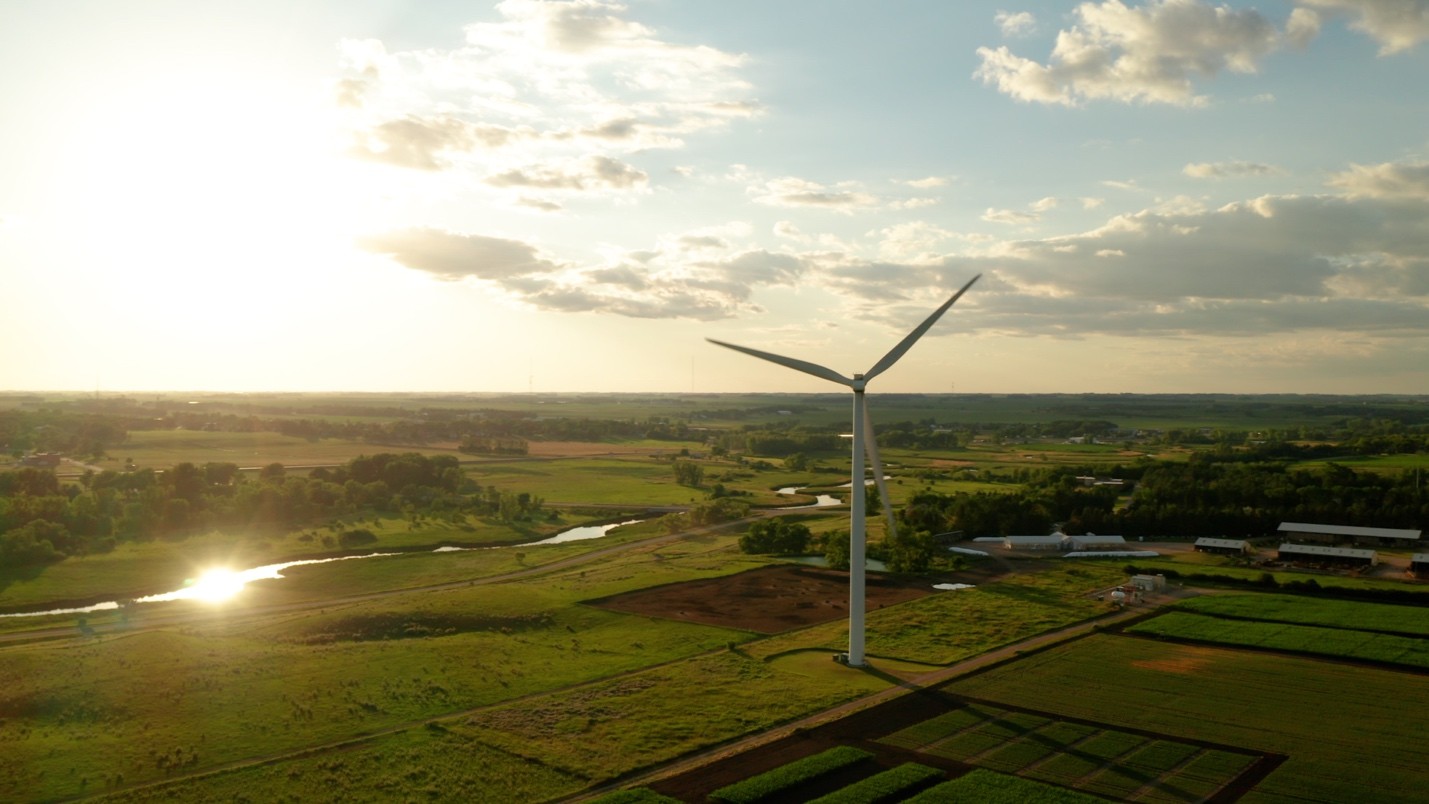
For more than two decades, the University of Minnesota Morris has been a national leader in campus sustainability. Located in the abundantly windy and sunny landscape of west-central Minnesota, the campus generates more than 60% of its daily electricity needs from on-site renewable resources, including wind power from its two iconic wind turbines and solar energy from campus solar arrays.
Generating renewable electricity, however, is only part of the challenge. During periods of especially high wind and solar production, the campus can produce more electricity than it needs. This is where energy storage comes in. Grid-scale batteries are a promising solution to capture excess energy supply and store it for future use. “We want to capture more of the green electrons we produce, and store them to enhance the viability of our renewable energy assets,” said Herrmann.
How the Electrical Storage System Will Fit Into UMN Morris’s Campus Infrastructure
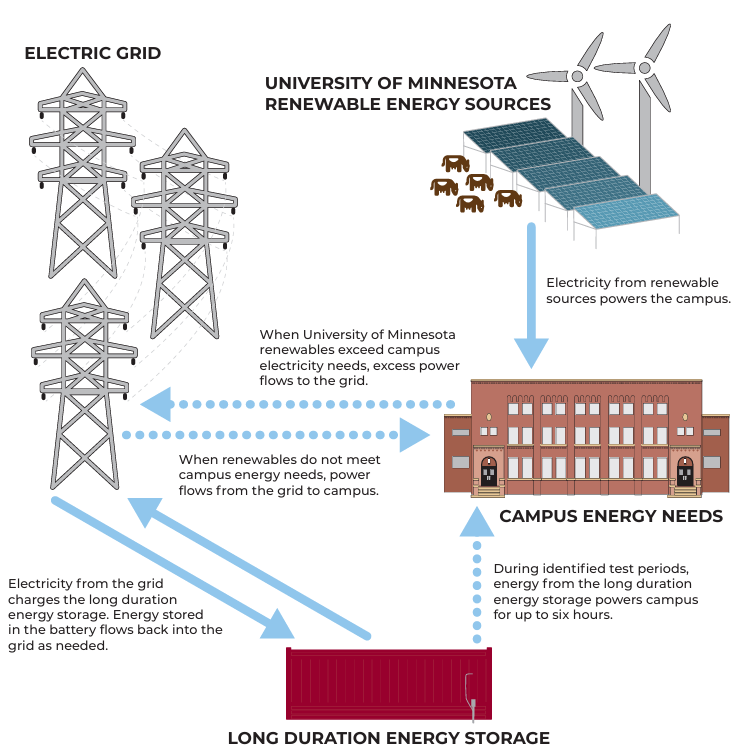
Illustration Credit: Kari Adams, University of Minnesota Morris
A Unique Partnership Model
The project brings together a public university, a utility, technology developers, and industry partners, with each playing a role in how the battery will be owned, operated, managed, and studied.
The partnership traces its roots back to a 2017 visit to California, when the University of Minnesota’s Institute on the Environment (IonE) awarded a Serendipity grant that enabled a team from UMN Morris to travel to the West Coast to learn about emerging storage technologies. “It was a transformative trip that sparked our energy storage work in Morris,” recalls Troy Goodnough, Director of Sustainability at UMN Morris.
During the visit, the group met with Commissioner Peterman at the California Public Utilities Commission where they learned how California was partnering with universities to deploy energy storage demonstration projects. These collaborations supported the deployment of energy storage projects by helping regulators better understand new technologies and reduce regulatory uncertainty. Now, nearly a decade later, California’s installed energy storage capacity has grown from roughly 500 megawatts in 2018 to more than 17 gigawatts by 2026 by playing a major role in addressing the state’s well-known “duck curve”.
“Our biggest takeaway from that trip was that universities, utilities, and regulators need to work together to make emerging technologies successful and solve some of the region’s toughest energy challenges,” Goodnough says.
That philosophy is reflected in this storage project: Under the partnership, Otter Tail Power will operate the Z3 system, connected directly to the utility’s electrical system. Because the installation will become part of Otter Tail Power’s infrastructure, the project underwent review by the Minnesota Public Utilities Commission (PUC), which approved the investment in March 2026.
“The University of Minnesota Morris has been an outstanding partner in bringing this project to life,” said Jason Grenier, Manager, Retail Energy Solutions at Otter Tail Power. “As Otter Tail Power’s first battery energy storage project, it also creates opportunities to learn how energy storage technologies may operate within our electric system over time.”
Under the partnership, while Otter Tail Power will use the Z3 system to support grid reliability, the university will have dedicated research periods throughout the project’s anticipated 20-year lifespan to study the battery’s performance under different operating scenarios.
OATI’s GridMind® software will manage and optimize the battery’s operation, including when it charges and discharges based on grid conditions and utility needs.
“This project is a strong example of what’s possible when a utility, a university, and a technology partner build something together instead of in parallel. GridMind® gives Otter Tail Power real-time control over how this battery supports the grid, while giving the university a live platform to advance long-duration, non-lithium storage research. That combination is exactly the kind of pilot the energy transition needs more of,” remarked OATI President & CEO Sasan Mokhtari.
OATI has been involved as a partner and advisor since the project’s earliest stages, including helping to develop the original project scope, and continues to provide technology and advisory support as the project moves toward deployment.
Moving Minnesota’s Clean Energy Future Forward
Because state funding has played a significant role in making this project possible, public engagement is an important part of the work. Locating the battery at the University of Minnesota Morris creates opportunities to make the technology visible and accessible for education, research, and community engagement. The system has been intentionally sited along a highly traveled campus walkway, where students, visitors, and community members will be able to see the technology firsthand.
The battery will join a diverse portfolio of energy technologies already operating on campus, including lithium-ion battery storage, wind turbines, solar arrays, and an agrivoltaics installation that combines agricultural production with solar energy generation on the same land.
UMN Morris also provides a valuable testing ground for emerging energy technologies because, from an energy perspective, the campus functions much like a small community. With nearly one million square feet of building space, approximately 1,500 people on campus each day, and a mix of residential, academic, and operational energy needs, the campus has a complex and consistent electricity demand. Studying the battery in this environment will allow researchers and utility partners to better understand its performance in day-to-day operation and explore how similar long-duration energy storage systems could support small communities across Minnesota.