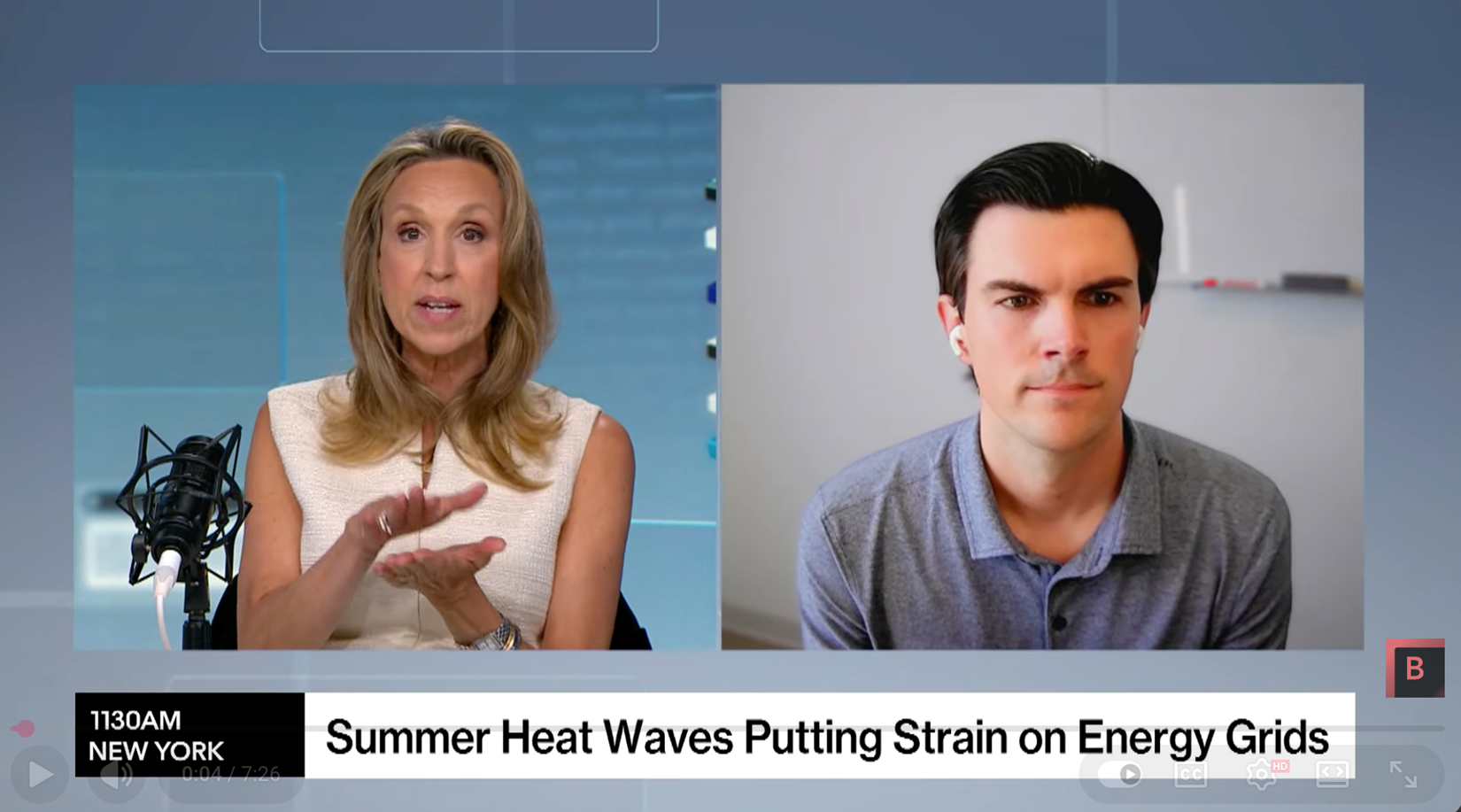
OATI Associate Vice President of Digital Strategy & Strategic Innovation John Engel joined Bloomberg to discuss how demand response, smarter transmission operations and energy-native AI can help utilities manage rising electricity demand.
Extreme heat is once again putting the relationship between everyday electricity use and grid reliability in the spotlight.
During a recent Bloomberg interview, OATI’s John Engel discussed why calls for consumers to adjust their thermostats are about more than conserving electricity. When coordinated across thousands of homes and businesses, relatively small changes in energy use can become a meaningful operational resource during the hours when the grid is under the greatest pressure.
Small changes can add up to a grid resource
A single customer changing a thermostat setting will not alter conditions across the power system. But utilities can aggregate thousands of participating thermostats, water heaters, batteries and other flexible devices into demand response programs that reduce or shift electricity use during peak periods.
Engel discussed OATI’s work supporting Con Edison’s demand response operations and the role coordinated customer participation can play during extreme heat events.
OATI’s demand response programs allow utilities to group participating devices, like smart thermostats and battery energy storage systems, pre-cool homes when appropriate and manage demand during peak hours while considering the customer experience. These programs are supported through OATI DERMS, which gives utilities a common platform for enrolling, aggregating and dispatching distributed energy resources.
Demand flexibility is becoming more important as utilities confront a combination of extreme weather, electrification, industrial development and rapid data-center growth. These pressures are not confined to one region or one unusually hot week. They are changing how utilities plan and operate the grid.
Building more is necessary—but it cannot be the only answer
New generation and transmission infrastructure will remain essential. The challenge is timing.
Large infrastructure projects can require years of planning, permitting and construction. Electricity demand is growing now.
That gap is one reason the U.S. Department of Energy established the $1.9 billion SPARK initiative to support technologies and infrastructure investments capable of increasing grid capacity and reducing costs.
Engel discussed OATI’s proposed PowerNow initiative, which would use advanced operational software and transmission technologies to unlock more usable capacity from infrastructure already in service.
The proposal combines near-real-time coordination among transmission providers, improved assessment of available transfer capability, ambient-adjusted and dynamic line ratings, artificial intelligence, flexible demand-side resources and expanded redispatch capabilities. Rather than waiting for an entirely new transmission system to be built, these enhancements would be deployed through operational platforms already used across much of the U.S. bulk power system.
The underlying idea is straightforward: the physical grid may have more capacity than current commercial and operational processes make available.
OATI already supports transmission owners, grid operators and reliability organizations with systems for scheduling, tagging, outage coordination, congestion management, line ratings and regulatory compliance. Those systems are built for the moments when operators must make decisions quickly under changing conditions.
Getting more from the grid we have
The themes discussed on Bloomberg—consumer flexibility, demand response, transmission capacity and AI—are closely connected.
Utilities need more infrastructure. They also need better ways to coordinate the infrastructure, distributed resources and operational information already available to them.
That means turning thousands of individual customer devices into dependable grid flexibility. It means improving the way neighboring transmission providers exchange information. It means identifying available capacity more accurately. And it means giving operators energy-native AI that improves situational awareness without removing them from the decision.
Together, these capabilities can help utilities address immediate reliability and affordability challenges while the industry continues building the grid required for the future.