The technology backbone that enabled the first RTO to span two interconnections
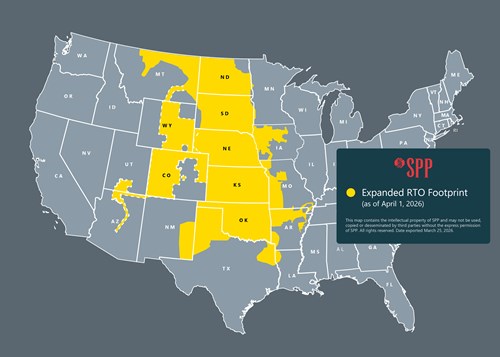
On April 1, 2026, Southwest Power Pool (SPP) became the first regional transmission organization in history to operate across both the Eastern and Western Interconnections of the U.S. power grid. The expansion extended SPP’s service territory into seven additional western states—Arizona, Colorado, Montana, Nebraska, New Mexico, Utah, and Wyoming—creating a 17-state, 732,000-square-mile integrated market serving 20 million people.
It is a landmark achievement for SPP, its member utilities, and the communities they serve. OATI is proud to have played a significant role in making this expansion possible.
The Scale of the Challenge
Bridging two interconnections is not a routine system upgrade. The Eastern and Western Interconnections operate on separate synchronized grids, connected only through a limited number of DC ties. Extending RTO services across that boundary meant rethinking how transmission reservations, scheduling, available transfer capability (ATC) calculations, and market integration would function in a system that had never been designed for this kind of unification.
Following months of intensive testing, simulation, and coordination with dozens of participating utilities, SPP’s expanded operations went live at midnight Central time on April 1. Nine load-serving utilities led the effort, and their participation brings access to SPP’s full portfolio of generating resources, planning services, and reliability coordination.
What OATI delivered
Behind the scenes, a significant amount of technology infrastructure had to be built, configured, and tested to make the expansion operational. OATI’s platforms were central to that effort.
Here is what OATI systems enabled:
- Unified AFC and ATC calculations across interconnections | OATI enabled a single, integrated available transmission capacity calculation spanning the expanded footprint, including across the DC ties connecting the Eastern and Western grids—a first-of-its-kind capability.
- Seamless cross-interconnection transmission reservations | For the first time, transmission customers can make seamless reservations across the Eastern and Western Interconnections through a single system—a service that has never existed before in the North American grid.
- Massive expansion of posted transmission paths | The number of posted transmission paths grew to over 9,000, reflecting the dramatically larger and more complex network now operating under SPP’s coordination.
- Expanded OASIS services | OATI’s webOASIS® platform was extended to incorporate the western transmission entities, providing market participants with transparent, open-access transmission information across the full SPP footprint.
- 85% improvement in AFC processing time | Despite a drastic increase in data points and transaction volumes, OATI implemented advanced AFC (Available Flowgate Capability) processes that reduced system processing time by 85%—a critical performance improvement for real-time grid operations.
- Scheduling for the new Western BAA | OATI’s scheduling platform was enhanced to support SPP’s new Western Balancing Authority Area, providing the operational backbone for generation-load balancing in the expanded territory.
- Model registration and consulting | Through OATI webRegistry®, the team provided grid expertise for model registration changes and all special modeling required for the Western BA integration.
- Market and settlement integration I OATI provided integration between transmission, scheduling, market, and settlement systems, transforming physical transaction data into market-node-compatible data streams on a Service Bus architecture.
- Advance reservation support | System changes were implemented to allow advance transmission reservations to begin months prior to the actual cutover date, accommodating FERC advance request rules and giving market participants the lead time they needed.
- Months of market trials support | OATI provided sustained operational support throughout the market trials period, working alongside SPP and its members to validate system readiness.
- Infrastructure upgrades | The underlying technology infrastructure was upgraded to support the expanded market’s increased computational and data demands.
And it was all delivered on time.
Why this matters
SPP’s western expansion is expected to deliver the same benefits SPP has demonstrated across its central U.S. footprint for decades: enhanced reliability, lower wholesale energy costs through regional dispatch, transparent governance, and efficient transmission planning that supports economic growth.
Operating as a coordinated system across a wider geography strengthens real-time situational awareness, enables the region to maximize diverse generating resources, and helps utilities navigate weather events and other threats to grid integrity. These benefits will continue to grow as new members integrate into SPP’s planning processes, markets, and reliability tools.
None of that happens without the operational technology infrastructure to support it. The ability to calculate transfer capability across interconnections, process reservations seamlessly, integrate scheduling with markets, and do it all at the speed that real-time grid operations demand. That is the work OATI was built to do.
Deep in operations, central to the mission
OATI has spent nearly three decades building the systems that North American grid operators depend on every day. Our platforms support over 95% of the continent’s transmission owners and reliability organizations. That operational depth is exactly what an effort like SPP’s western expansion requires: systems that are proven, scalable, and built by a team that understands how the grid actually works.
We congratulate SPP and its member utilities on this historic achievement, and we’re proud of the role our technology and team played in making it a reality.